Singapore Patent Foreign Filing Licences: Who is Caught Under Section 34?
Singapore Intellectual Property Blog
Singapore patent law places restrictions on certain patent applications being filed outside Singapore without prior clearance from IPOS.
Section 34 of the Patents Act 1994 provides that:
“no person resident in Singapore may, without written authority granted by the Registrar, file or cause to be filed outside Singapore an application for a patent for an invention”
unless an application for the same invention has been filed in Singapore at least two months earlier and no directions under Section 33 remain in force. There is an exception where an application for the invention was first filed outside Singapore by a person resident outside Singapore.
Section 33 further provides for directions restricting publication or communication of information where it may be prejudicial to the defence of Singapore or the safety of the public. IPOS refers to written authority under Section 34 as “national security clearance”. Practitioners will often refer to this as a “foreign filing licence”.
Under the Patents Act, a contravention of Section 34 is a criminal offence. A person who files or causes an application to be filed contrary to the section may, on conviction, be fined up to S$5,000, imprisoned for up to two years or both.
Against that background of possible criminal sanctions, it is important to understand what the expression “person resident in Singapore” means, and whether, in particular, a “person” can include a company.
How the Question Arose
We were recently asked to advise on a proposed first filing at the UK Intellectual Property Office.
The facts were these: an invention had been made outside Singapore by an inventor who was not resident here. The inventor worked for a company which was a subsidiary of a Singapore company (a private limited company). The proposed applicant for the UK patent application was the Singapore company.
In checking whether Section 34 clearance was required, the foreign patent attorney handling the filing found an answer published by IPOS on the AskGov website.
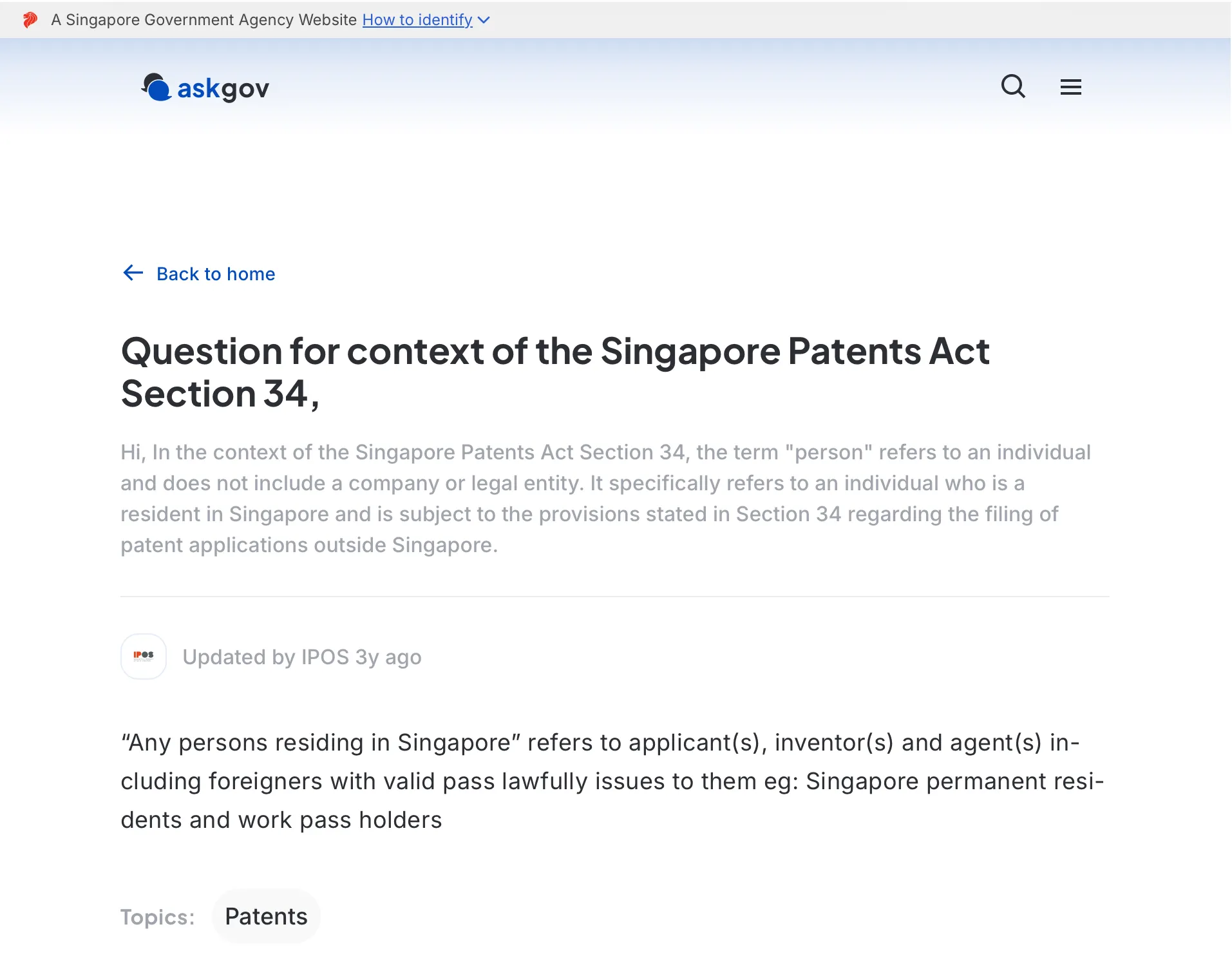
As shown above, the page states:
“the term ‘person’ refers to an individual and does not include a company or legal entity.”
It goes on to say that the term refers to an individual resident in Singapore and later explains that persons residing in Singapore may include applicants, inventors and agents, including certain foreigners holding valid passes.
If that guidance were correct, the proposed Singapore corporate applicant could be excluded from the Section 34 analysis simply because it was a company.
We did not however think that was a safe interpretation.
What do the Patents Act and IPOS Guidance say?
Section 2(1) of the Patents Act (“Interpretation”) sets out definitions of terms used in the Act. It provides that, in the Patents Act, a:
“person” includes the Government;
The definition is inclusive and does not state that ‘person’ only refers to a natural person.
Section 102 of the Patents Act also contemplates offences under the Patents Act. The section states that both a body corporate and an officer of that body may be guilty of an offence under the Act.
Of course, Section 102 cannot and does not conclusively determine the construction of Section 34. However, it provides further support against a construction of “person” as only referring to a natural person.
The IPOS Patents Formalities Manual at paragraph 11.4.10 provides further guidance:
“A person resident in Singapore could be an applicant or an inventor named in the patent application first filed outside Singapore. This could include a natural person, the Government, as well as any company or association or body of persons corporate or unincorporated.” (emphasis added)
The Formalities Manual therefore expressly states that a “person resident in Singapore” may include a company. It is difficult to reconcile this with the AskGov statement that “person” refers to an individual and excludes a company or legal entity.
In our view, the better interpretation is that a company can indeed be a “person” for the purposes of Section 34. Corporate status alone therefore does not take an applicant outside the provision. There remain separate questions as to whether the particular company is resident in Singapore and whether it has filed or caused the overseas application to be filed.
Nevertheless, for the proposed UK filing, we advised against relying on the AskGov answer and recommended obtaining written authority (a “foreign filing licence”) before filing in the UK.
IPOS has Agreed to Correct the AskGov Page
We wrote to IPOS on 5 August 2026 drawing attention to the apparent conflict between the AskGov answer, the Patents Act and paragraph 11.4.10 of the Formalities Manual. IPOS replied on 7 August 2026:
“We have reviewed the AskGov page in question and we apologise for any confusion this may have caused.”
IPOS added:
“We will arrange for the affected page to be corrected.”
IPOS’s response does not provide a legal analysis of the meaning of “person”, nor does it address the test for corporate residence. It does, however, confirm that IPOS has reviewed the page and intends to correct it. The decision to correct the page appears to indicate that IPOS does not consider the statement excluding companies to be correct.
At the time of writing, though, the wording shown above remains on the AskGov page.
A Wider Point About AskGov Guidance
AskGov may be useful for straightforward procedural questions. However, we consider that greater care is required where an enquiry depends on statutory interpretation, particularly where the answer may determine whether a criminal offence has been committed.
Even the Patents Formalities Manual states that it is based on IPOS’s interpretation of the applicable law and practice and that its contents do not constitute legal advice. It advises readers to approach a legal professional if legal advice is required.
Where an AskGov question requires interpretation of the Patents Act, rather than (say) an explanation of IPOS procedure, we consider that referring the enquirer to a suitably qualified patent attorney may be preferable to giving a short answer which could be misunderstood as settling the legal position.
What Should be Considered Before a First Filing?
Where a patent application first disclosing an invention is intended to be filed outside Singapore, the Section 34 position should be considered carefully, and by reference to all persons involved in the proposed filing. This may include a consideration of who the applicant should be and where that applicant is resident, whether any inventor is resident in Singapore and whether there are any other persons resident in Singapore who may file or cause the application to be filed outside Singapore.
As explained above, the enquiry should not be confined to natural persons. A company or other corporate entity may also be a “person” for the purposes of Section 34. Accordingly, corporate applicants and other corporate entities involved in filing or causing the application to be filed should also be considered, including where they are resident and what role they have in the proposed filing.
Given the criminal consequences of a contravention of the Section 34 provisions, we consider it prudent for those questions to be addressed before the foreign filing is made. Where the position is uncertain, appropriate professional advice should be obtained and written authority from IPOS sought where necessary.