Can You Register a Patent in Singapore? Patent Registration and Provisional Applications Explained
Singapore Intellectual Property Blog
Someone trying to find out how to register a patent in Singapore, or who is looking for information about Singapore patent registration, will often begin with the Intellectual Property Office of Singapore (IPOS) website. IPOS uses expressions such as “patent registration” and “provisional application” in some of its public guidance.
Those expressions do not, however, reflect the terminology or structure of Singapore patent law. A patent is granted rather than “registered”, while the legislation does not create separate “provisional” and “complete” classes of patent application. This terminology can affect how applicants understand the Singapore patent application process, what is required at the initial filing stage and what may be done later.
“Patent Registration” and “Provisional Applications” on the IPOS Website
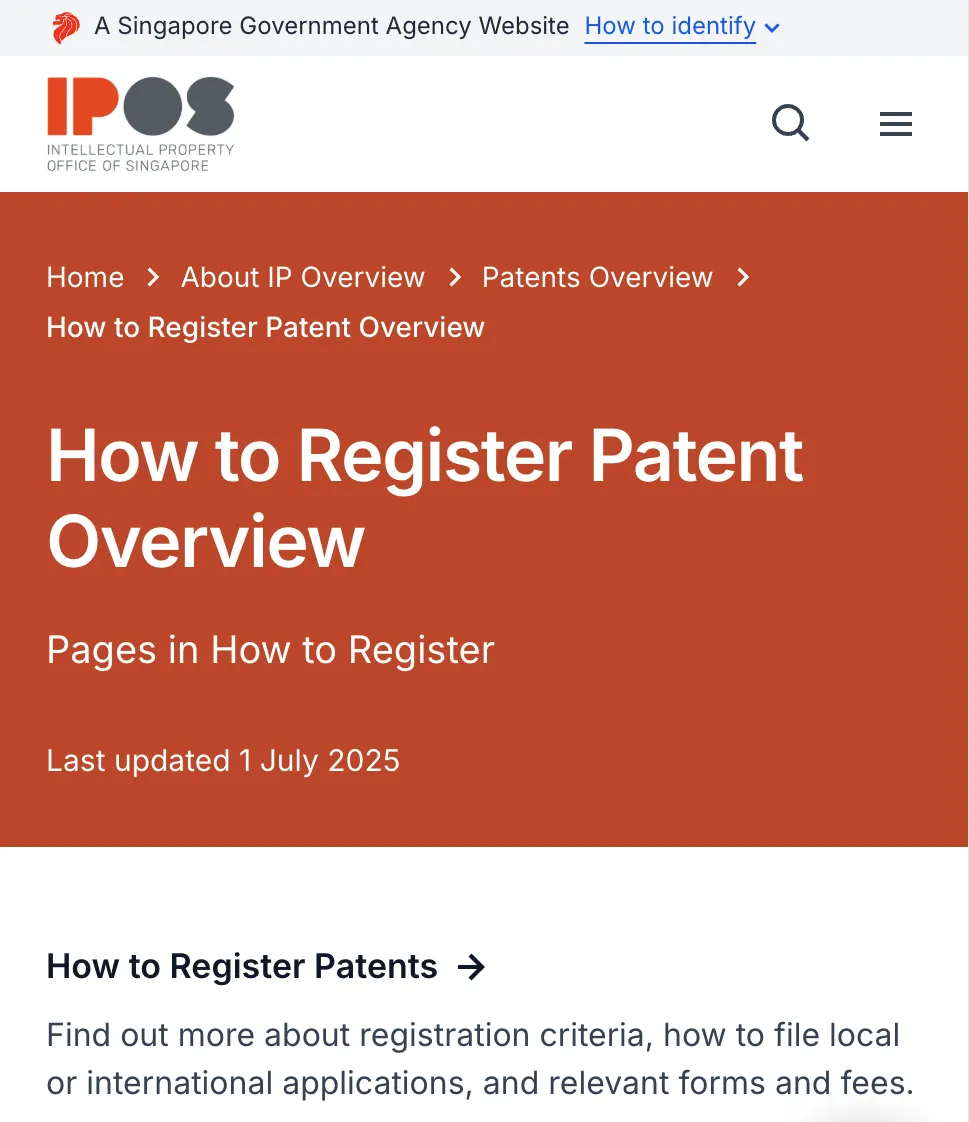
On some of its pages, the IPOS website describes the process of obtaining a patent as “registration”. The overview page, for example, is headed How to Register Patent Overview. The main page setting out the guidance is headed How to Register Patents and refers to a “registration process”, “registration criteria”, “patent registration” and a “registration timeline”.
IPOS also has a page headed provisional application. It describes a “provisional patent application process”, its “conversion to a complete application” and the benefit of a “simplified filing requirement and lower patenting cost”.
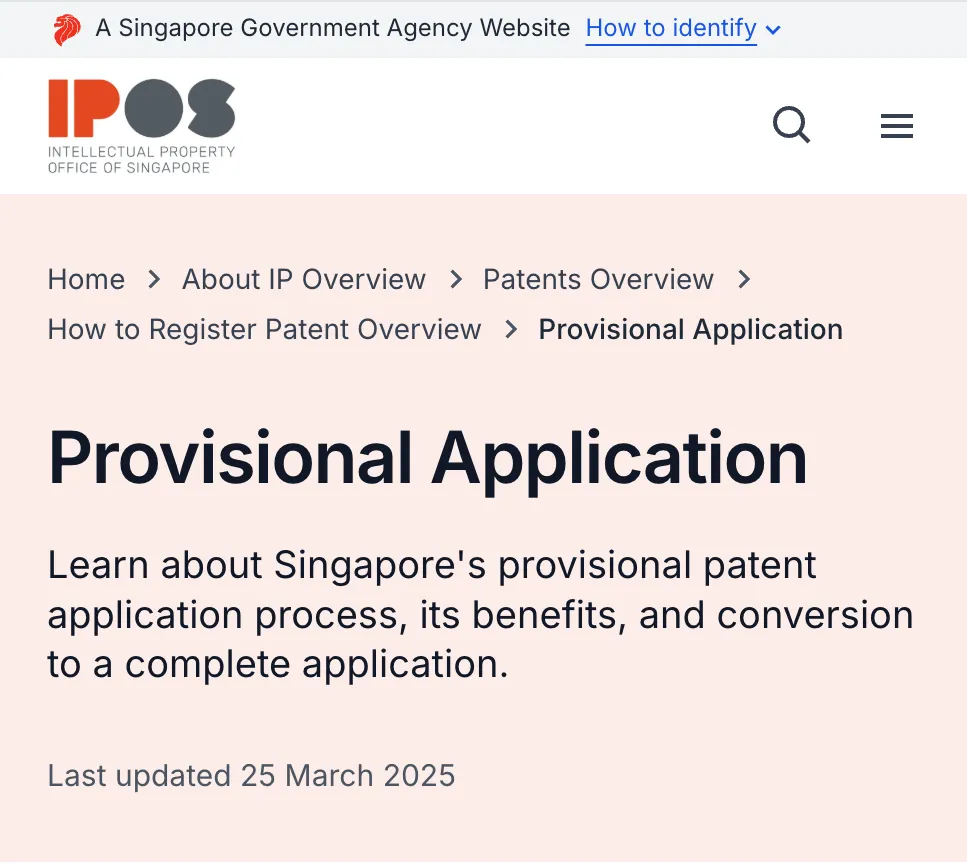
The same page advises that patent applications should be technically and legally accurate and that applicants may consider engaging a registered patent agent. However, in our view, the terminology used elsewhere on the page may still give applicants the wrong impression about the legal process and the work involved.
Can You Register a Patent in Singapore?
If you search for “Singapore patent registration” or “how to register a patent in Singapore”, you are generally looking for the process of obtaining patent protection in Singapore. That process involves filing a patent application with IPOS, search and examination and, if the requirements are satisfied, grant of the patent. For an overview of the actual procedure, see our Singapore Patent Guide.
The Patents Act 1994 uses “grant” when describing the outcome of the application and examination process. Section 30 provides that the Registrar “must grant the applicant a patent” if the conditions in that section are satisfied. Section 35 deals with publication of grant and the issuance of a certificate of grant. Section 36(1) states that the patent takes effect on the date on which the certificate of grant is issued. The Patents Act does not refer to the process of obtaining a patent as “registration”.
The Act does use the term “registration”, but in a different context. Section 42(1) requires the Registrar to maintain the Register of Patents, while Section 42(2)(a) allows the Rules to provide for “the registration of patents and of published applications for patents”. Rule 55 of the Patents Rules then identifies the particulars entered in the Register, including the date on which a patent is granted.
“Registration” in this context therefore concerns the recording of information in the Register. It should not be confused with the substantive process by which an applicant applies for a patent, the application is examined and IPOS grants the patent.
We believe it would be better for IPOS’s public guidance to use expressions such as “how to obtain a patent”, “applying for a patent”, “patent application process” and “grant of a patent”. These expressions describe more accurately what the applicant is seeking and the role performed by IPOS.
The term “registration” may also be misleading as it risks suggesting a largely administrative procedure, comparable to registering a business name or recording ownership of an asset. In our view, that does not adequately convey the work involved in identifying and defining an invention, preparing a patent specification and dealing with objections during examination.
An applicant may therefore underestimate the time and professional work required to obtain a patent, including the work involved in identifying and defining the invention, preparing an adequate patent specification and prosecuting the application before IPOS.
Our guide to filing a Singapore patent application explains the usual documents and filing procedure in more detail.
Can You File a Provisional Patent Application in Singapore?
Singapore does not have a separate class of patent application called a “provisional patent application” under the Patents Act or Patents Rules. However, a Singapore patent application can receive a filing date without claims if the statutory requirements for obtaining a filing date are satisfied. One or more claims must then be filed within the prescribed period if the application is not to be treated as abandoned.
Section 25(3) sets out the documents which every application must contain, including a description and one or more claims. However, it also allows an application to be initiated by documents complying with Section 26(1), which permits a filing date to be obtained without claims. Section 26(12)(a) however requires one or more claims to be filed within the prescribed period if the application is not to be treated as abandoned. The legislation therefore provides for claims to be filed later in the same application. It does not, however, create separate “provisional” and “complete” classes of application or provide for conversion between them.
It therefore seems to us that a clearer description of such applications would be an application “initiated without claims” or “filed without claims”.
Omitting Claims May Not Reduce Drafting Work
Section 25(5)(a) of the Patents Act 1994 requires the claims to define the matter for which the applicant seeks protection. Preparing claims requires careful thought about the applicant’s commercial product or process, possible variants and the known prior art.
In practice, many patent attorneys draft the claims first. The description and drawings may then be prepared by reference to the protection sought, as set out by the claims. This helps the attorney to ensure that the specification explains how the invention may be performed, supports the claims and contains useful alternatives or fallback positions if broader claims cannot be maintained during examination.
For this reason, where an applicant has instructed a patent attorney to prepare a patent specification, omitting the claims at filing is unlikely to produce a substantial saving in professional fees. This is because much of the analysis needed to frame the claims and prepare a description capable of supporting them will already have been done.
IPOS’s reference to a “simplified filing requirement and lower patenting cost” may nevertheless suggest that obtaining an early filing date without claims is a relatively simple and inexpensive step, without adequately conveying the professional work that may still be required to prepare an adequate patent specification before filing.
The official guidance issued by IPOS should therefore not imply that filing without claims removes the need to prepare an adequate first filing or necessarily results in substantially lower professional costs.
The Risks of an Inadequate First Filing
Section 25(4) requires the specification of a patent application to disclose the invention clearly and completely enough for a person skilled in the art to perform it. Section 25(5)(c) requires the claims to be supported by the description. In addition, Section 84(3) does not allow an amendment before grant if it would result in the application disclosing matter extending beyond what was disclosed when the application was filed.
Because of this, missing technical matter cannot simply be added later during examination before the Office. A sparse description may leave the applicant unable to pursue the breadth of protection later found to be commercially important or to add useful fallback positions during examination.
Section 17(2)(a) allows subject matter in a later application to take the filing date of an earlier application as its priority date only if it is “supported by matter disclosed” in the earlier application. Despite its early filing date, an earlier application may therefore be of little or no use as a priority application if it does not disclose enough of the relevant subject matter to support the priority claim made in the later application.
The page should therefore warn applicants that the value of an early filing depends on what the document filed on that date discloses. Otherwise, applicants may focus on securing an early date without understanding the importance of preparing an adequate specification.
How IPOS Could Improve the Guidance
IPOS could, in our view, improve the guidance without making it less accessible. The relevant web pages could be renamed and revised to refer to “applying for” and “obtaining” a patent. The present “provisional application” page could instead explain, using the terminology of the Act and Rules, how an application may obtain a filing date without claims, the period for filing those claims and the limits on adding subject matter later.
These changes would give first-time applicants a more accurate account of the process. They would also help applicants make realistic decisions about timing, drafting and cost before an important filing date is fixed.
What Applicants Should and Shouldn’t Do
An early filing should be treated as the foundation of the protection sought, not simply as a means of reserving a date. Before filing, an applicant should consider the commercially important embodiments, the variants a competitor might adopt and whether the specification contains enough technical information and fallback positions to support useful claims. In our view, these questions should be considered with a patent attorney as early as possible.
In particular, applicants should not simply file an existing manuscript, technical report or other in-house document to obtain an early filing date. Such documents are generally prepared to report particular experiments, results or embodiments, rather than to define the invention and support the scope of protection sought. They may therefore focus on a narrow embodiment, omit variants and alternatives and lack the broader disclosure or fallback positions needed to support commercially useful claims. If a properly prepared specification cannot be completed before the intended filing date, the applicant should seek urgent advice before deciding what, if anything, should be filed.
Frequently Asked Questions
How do I register a patent in Singapore?
Strictly speaking, a patent is granted rather than registered in Singapore. An applicant files a patent application with IPOS, which must proceed through a search and examination procedure before it can be granted.
Does Singapore have provisional patent applications?
No. The Patents Act and Patents Rules do not establish a separate class of “provisional patent application”. A Singapore patent application may, however, obtain a filing date without claims. The claims must subsequently be filed within the prescribed period.
Can I file a Singapore patent application without claims?
Yes. An application may obtain a filing date without claims if the filing-date requirements are satisfied. This does not remove the importance of preparing an adequate description at the outset.
Can I add information to a provisional patent application later?
Calling the initial filing a “provisional application” does not permit new technical subject matter to be added freely later. Amendments before grant cannot extend beyond the matter disclosed in the application as filed.